

Lessons from Pérouges and how Cycle Pulse helps Domžale’s old city
Many European towns struggle to balance tourism with quality of life for residents. The medieval village of Pérouges in France, for example, uses pedestrian and bicycle counters to identify the busiest streets and to manage visitor traffic. Eco‑Counter’s case study notes that the town is a major heritage site and an inhabited village; counting data helps managers decide when and how to regulate access in narrow streets and to schedule maintenance without disrupting residents . Domžale’s old town faces similar challenges on market days and during cultural festivals.
Portable, non‑invasive monitoring
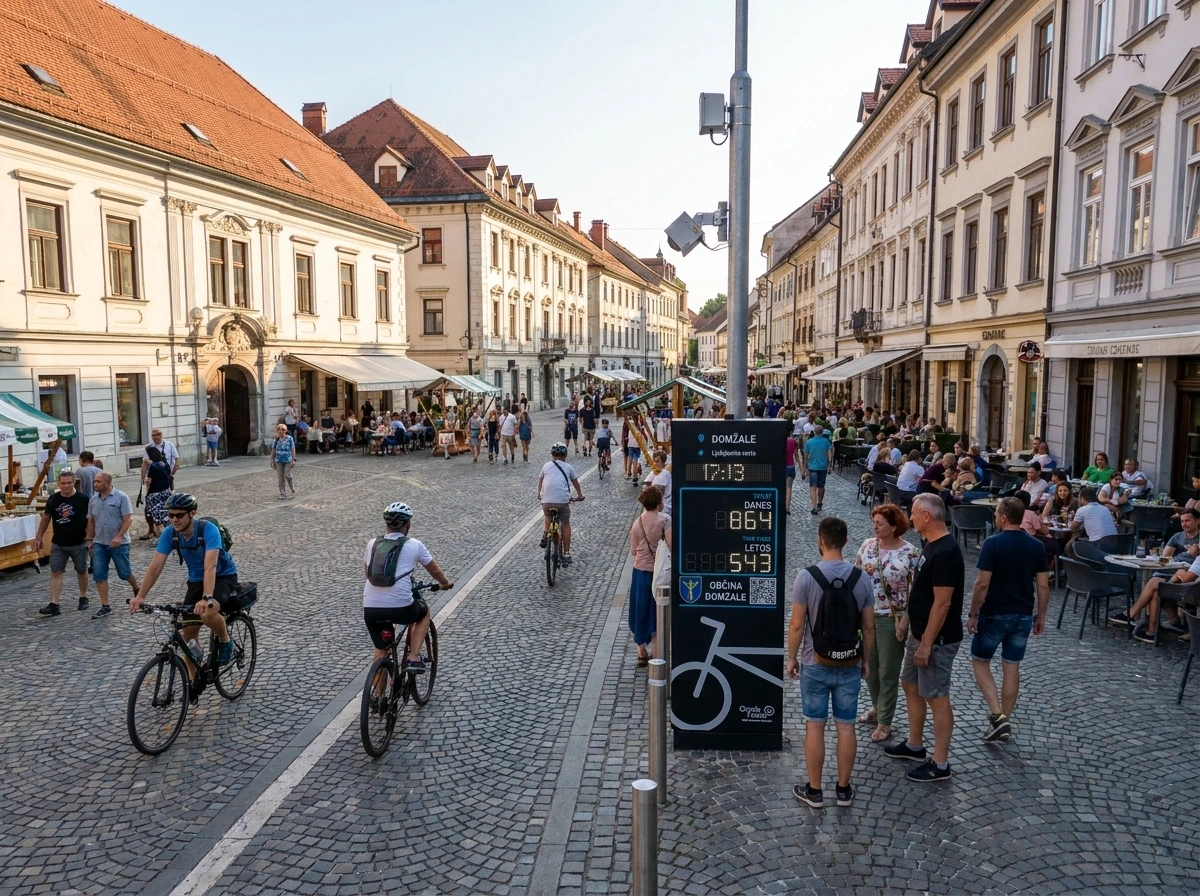
A major advantage of the Cycle Pulse system is that it requires no road excavation and can be installed in two to four hours. In heritage areas where digging might damage cobblestones or underground utilities, the counter can be mounted on existing street furniture or attached to a lamppost. The LiDAR sensor classifies cyclists, e‑scooter riders and pedestrians separately, so planners know whether congestion is coming from tourist groups on foot or from local commuters on bikes. Because the entire unit, including the LED display, weighs around 45 kg and is IP65‑rated, it withstands outdoor conditions yet can be moved between streets as needed.
Domžale has used its single counter to monitor foot traffic during summer festivals in the medieval marketplace. Data from the counter showed that pedestrian flow peaks around 10:30 am and again at 6 pm, with cyclists mostly using peripheral streets. Armed with this information, the town’s cultural office adjusted event schedules, added temporary bike parking on side streets and deployed more staff during peak hours. The cloud platform’s interactive maps and automated reports made it easy to communicate findings to event organisers and local businesses.
Replicating best practices for other municipalities
Pérouges’ example shows that counting visitors and managing traffic in historic districts protects both heritage and quality of life.
Domžale’s experiment proves that the same benefits are achievable with modern LiDAR counters. Because Cycle Pulse is compatible with EU grant‑funded projects and can generate compliant data, municipalities can justify investments in pedestrianisation, signage or traffic calming. As more Slovenian towns adopt similar counters, they will gain a clearer picture of how tourism and daily life interact and can design policies that respect residents while sustaining economic activity.
Pérouges’ example shows that counting visitors and managing traffic in historic districts protects both heritage and quality of life.
Benefits of Cycle Pulse
- Protects sensitive heritage areas – no digging or asphalt cutting is required, so the system is suitable for historic streets, squares, and protected urban areas.
- Separates visitor types – the system distinguishes between pedestrians, cyclists, and e-scooter users, which helps municipalities understand what is really causing congestion.
- Supports event and visitor management – the cloud platform provides real-time monitoring, interactive maps, and automated reports for planning staffing, access, and crowd flow.
- Works reliably outdoors – the hardware is IP65-rated and designed for all-weather operation, which is important for year-round use in busy public spaces.
Previous Story
Domžale leads the way with Cycle Pulse
Next Story